
This house has been a landmark of rural Bulloch County for over a century. Overgrown shrubs and vines have recently been cleared, and though the house seems too far gone to be saved at this point, Harville descendants who still own the property are working hard to find viable options for its restoration. According to a fellow photographer who attended Georgia Southern in the early 1970s, the house was abandoned then, and was called the “Haunted House” by students and locals alike.
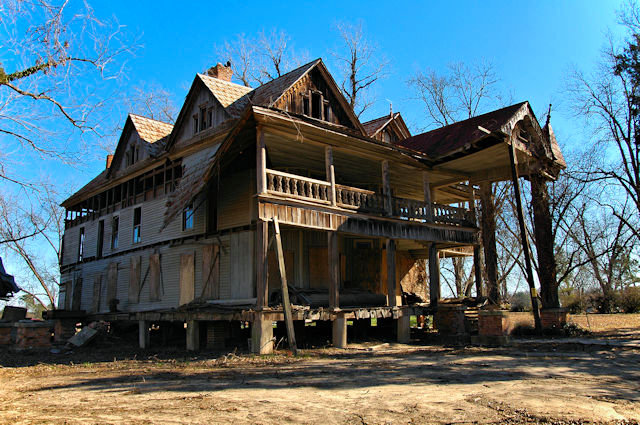
Here’s a view from the west front today, and as it looked in its early days.

Vintage Photograph Courtesy Statesboro Regional Library

In 2013 the Bulloch County Historical Society, with assistance from the Jack N. and Addie D. Averitt Foundation, placed a marker explaining its history. The house is on private property and should be photographed from the road only. From the historic marker: Samuel Winkler Harville purchased this 754-acre farm in 1862. Born on December 17, 1826, Harville was one of two delegates Bulloch County sent to the 1861 Secession Convention in Milledgeville. He voted for Georgia to secede from the Union.
Samuel’s son, Henry Keebler Harville, purchased the property and built the Harville House as a one-story house around 1894. The second story was added ten years later, resulting in a total of 14 rooms to accommodate a growing family. The vernacular architectural features of the house were inspired by a dream of Keebler Harville. The lumber used was cut and sawn from timber grown on the farm. By the time of Keebler’s death in 1946, the farm had grown to 2800 acres. More than just a landmark, the farm was self-sustaining for 10 families. It included a grist mill, saw mill, cotton gin, two-story smokehouse, ice house, syrup house, and a commissary. He was the first in Bulloch County to sell peanuts commercially and picked peanuts commercially for other farmers from Blitchton to Claxton. He purchased the first corn snapper in the county.
The Harville Cemetery is located 1/4 mile west of the house.


No comments:
Post a Comment